Introduction
Toothache is one of the most common reasons patients seek dental care. However, identifying the source of pain is not always straightforward.
Patients may complain of pain in one tooth while the actual pathology lies elsewhere. In some cases, pain of non-dental origin may mimic odontogenic pain and lead to misdiagnosis.
A systematic approach to differential diagnosis is therefore essential for appropriate treatment planning.
The goal of diagnosis is not simply to identify the painful tooth, but to determine the underlying cause of pain and establish an evidence-based treatment plan.
Step 1: Take a Detailed History
A good diagnosis often begins before any instrument touches the patient.
Important questions include:
Site
- Which tooth hurts?
- Can the patient localize the pain?
Onset
- When did the pain start?
- Sudden or gradual?
Character
- Sharp?
- Dull?
- Throbbing?
- Electric shock-like?
Duration
- Seconds?
- Minutes?
- Hours?
Aggravating Factors
- Hot food?
- Cold drinks?
- Chewing?
- Sweet foods?
Relieving Factors
- Cold water?
- Analgesics?
- Nothing at all?
The pattern of pain often provides important clues regarding the underlying pathology.
Step 2: Consider Pulpal Causes
Pulpal pain is one of the most common causes of toothache.
Reversible Pulpitis
Characteristics:
- Sharp pain.
- Triggered by cold or sweet stimuli.
- Pain disappears after removal of stimulus.
- No spontaneous pain.
Treatment:
- Remove irritant.
- Restore the tooth.
Irreversible Pulpitis
Characteristics:
- Spontaneous pain.
- Lingering pain after cold.
- May worsen at night.
- Difficult for patient to localize.
Treatment:
- Root canal treatment.
- Extraction if tooth is non-restorable.
Pulp Necrosis
Characteristics:
- Tooth may be asymptomatic initially.
- Pain develops if periapical tissues become involved.
- May show periapical radiolucency.
Step 3: Evaluate Periodontal Causes
Pain arising from periodontal tissues is often:
- Localized. Associated with chewing.
- Tender on percussion.
- Associated with gingival inflammation or swelling.
Common causes include:
Acute Periodontal Abscess
Features:
- Severe localized pain.
- Swelling.
- Tooth mobility.
- Pus discharge may be present.
Acute Necrotizing Ulcerative Gingivitis (ANUG)
Features:
- Severe gingival pain.
- Ulceration.
- Bleeding.
- Halitosis.
Step 4: Think About Cracked Tooth Syndrome
Patients may report:
- Sharp pain on biting.
- Pain when releasing pressure.
- Difficulty identifying the affected tooth.
Clinical clues:
- Deep restorations.
- History of chewing hard objects.
- Pain reproduced with bite tests.
This condition is frequently overlooked.
Step 5: Consider Referred Pain
The painful tooth may not be the diseased tooth.
Examples:
- Maxillary molar pain referred to adjacent teeth.
- Pulpitis causing diffuse pain.
- TMJ disorders presenting as toothache.
Failure to consider referred pain may result in treatment of the wrong tooth.
Step 6: Rule Out Non-Odontogenic Pain
Not all toothaches originate from teeth.
Possible causes include:
Maxillary Sinusitis
Features:
- Pain in multiple upper posterior teeth.
- History of sinus infection.
- Tenderness over sinus area.
Trigeminal Neuralgia
Features:
- Sudden electric shock-like pain.
- Triggered by light touch.
- Lasts seconds.
- Severe intensity.
Temporomandibular Disorders
Features:
- Muscle tenderness.
- Joint sounds.
- Pain aggravated by jaw movement.
Red Flags
Further investigation is required when:
🚩 Pain cannot be localized.
🚩 Clinical findings do not explain symptoms.
🚩 Multiple teeth are painful.
🚩 Neurological symptoms are present.
🚩 Conventional dental treatment fails to relieve pain.
Clinical Pearls
✓ Never begin treatment before establishing a diagnosis.
✓ Pain location does not always indicate the diseased tooth.
✓ History taking is often more valuable than radiographs.
✓ Always consider non-odontogenic causes when findings are inconsistent.
✓ Treat the cause of pain, not merely the symptom.
Key Takeaway
The differential diagnosis of toothache requires a systematic approach that combines history taking, clinical examination, radiographic interpretation, and critical thinking.
A clinician who develops strong diagnostic skills avoids unnecessary procedures, improves patient outcomes, and gains confidence in treatment planning.
Related Handbook
This topic is discussed in greater detail in:
Dental Dose Clinical Handbook Volume I
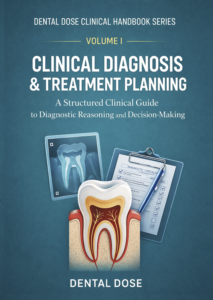
Clinical Diagnosis & Treatment Planning
- History taking
- Differential diagnosis
- Clinical examination
- Radiographic interpretation
- Decision-making algorithms
Available on the Dental Dose Store.