Introduction
Composite resin has become the material of choice for most direct esthetic restorations. Modern adhesive systems and improved restorative materials have significantly increased clinical success.
However, despite advances in materials, composite restorations continue to fail—not because the material is inadequate, but because of errors in diagnosis, case selection, isolation, bonding, placement, or finishing.
Understanding why restorations fail is often more valuable than simply learning how to place them.
This article discusses the most frequent causes of composite restoration failure and the clinical principles that help prevent them.
1. Poor Case Selection
Not every cavity is an ideal indication for composite.
Examples include:
- Patients with uncontrolled bruxism
- Large stress-bearing restorations
- Poor oral hygiene
- Inability to maintain isolation
Selecting the wrong restorative material may compromise longevity before treatment even begins.
2. Inadequate Isolation
Moisture contamination remains one of the leading causes of adhesive failure.
Contamination may occur from:
- Saliva
- Blood
- Crevicular fluid
Even brief contamination can significantly reduce bond strength.
Whenever possible, rubber dam isolation should be considered the standard of care.
3. Incorrect Adhesive Technique
Successful bonding depends on following the manufacturer’s protocol precisely.
Common errors include:
- Over-drying dentin
- Inadequate solvent evaporation
- Insufficient adhesive application
- Failure to light cure adequately
The adhesive layer is the foundation of the restoration.
4. Polymerization Shrinkage Stress
All resin composites undergo polymerization shrinkage.
Excessive shrinkage stress may lead to:
- Marginal gaps
- Postoperative sensitivity
- Marginal staining
- Secondary caries
Reducing the C-factor and using incremental placement can minimize stress development.
5. Bulk Placement
Large increments reduce light penetration and increase polymerization stress.
Incremental layering improves:
- Degree of conversion
- Adaptation
- Marginal integrity
6. Inadequate Light Curing
A restoration cannot become stronger than the light energy it receives.
Common problems include:
- Weak curing lights
- Short curing times
- Dirty light tips
- Excessive distance from restoration
Clinicians should periodically verify curing light output.
7. Poor Matrix Adaptation
Improper matrix placement can result in:
- Open contacts
- Food impaction
- Gingival inflammation
- Overhangs
Modern sectional matrix systems generally provide superior proximal contacts in posterior composites.
8. Occlusal Errors
Even a perfectly bonded restoration may fail if occlusion is ignored.
High occlusal contacts increase:
- Fracture risk
- Marginal breakdown
- Postoperative discomfort
Occlusion should always be reassessed after finishing and polishing.
9. Inadequate Finishing and Polishing
Surface roughness promotes:
- Plaque accumulation
- Staining
- Gingival irritation
Proper finishing also improves esthetics and patient comfort.
10. Ignoring Caries Risk
Replacing a restoration without addressing the patient’s caries risk often leads to repeated failure.
Successful restorative dentistry extends beyond the restoration itself.
Diet, oral hygiene, fluoride exposure, and recall intervals all influence longevity.
Clinical Checklist Before Dismissing the Patient
Before completing every composite restoration, ask:
✅ Is isolation maintained?
✅ Are margins fully sealed?
✅ Is proximal contact adequate?
✅ Is occlusion checked?
✅ Has finishing and polishing been completed?
✅ Have postoperative instructions been explained?
Clinical Pearls
✓ Composite failure is usually technique-related rather than material-related.
✓ Rubber dam isolation significantly improves bonding reliability.
✓ Light curing quality directly influences restoration longevity.
✓ Never rush finishing and polishing.
✓ Long-term success begins before the first increment is placed.
Key Takeaway
Composite restorations rarely fail because of a single mistake.
Most failures result from the cumulative effect of small clinical errors occurring throughout diagnosis, isolation, bonding, placement, curing, and finishing.
Clinicians who consistently follow evidence-based restorative protocols can dramatically improve the longevity and predictability of composite restorations.
Related Handbook
This topic is discussed in greater detail in:
Dental Dose Clinical Handbook Volume III – Operative & Conservative Dentistry
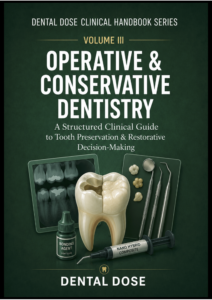
Including:
- Adhesive dentistry
- Composite placement protocols
- Matrix systems
- Clinical troubleshooting
- Restorative decision-making
Available on the Dental Dose Store.
👇🏼👇🏼 More topics you might be interested in 👇🏼👇🏼