Introduction
Artificial intelligence (AI) has rapidly expanded from a research concept to a practical tool in modern dentistry. Several commercially available software platforms can now analyse bitewing and periapical radiographs, automatically highlighting potential proximal carious lesions, bone loss, calculus, and other radiographic findings.
Supporters believe AI can improve diagnostic consistency and help clinicians detect subtle lesions that might otherwise be overlooked. Critics argue that over-reliance on AI may increase false-positive diagnoses and unnecessary treatment.
The important question is no longer whether AI can detect caries – but whether it is ready to become a routine part of everyday clinical dentistry.
What is AI-Assisted Caries Detection?
AI-assisted caries detection uses deep learning algorithms trained on thousands of annotated dental radiographs.
When a radiograph is uploaded, the software analyses image patterns and highlights areas that may represent:
- Initial enamel caries
- Dentinal caries
- Recurrent caries
- Proximal lesions
- Occasionally secondary findings such as calculus or bone loss (depending on the platform)
Importantly, the AI does not diagnose disease independently. Instead, it acts as a clinical decision-support tool, drawing the clinician’s attention to suspicious areas.
How Accurate Is AI?
Recent systematic reviews and clinical studies suggest that modern AI systems can achieve high sensitivity for detecting proximal caries on bitewing radiographs, often performing similarly to experienced clinicians under controlled conditions. However, performance varies depending on:
- The quality of the training dataset.
- The type of radiograph.
- The prevalence of disease.
- The specific AI model being used.
High sensitivity is beneficial because fewer lesions are missed. However, increased sensitivity may sometimes come at the expense of specificity, leading to false-positive alerts.
This means that every highlighted lesion should still be interpreted within the context of the patient’s history, clinical examination, and radiographic findings.
Potential Advantages
1. Improved Diagnostic Consistency
AI applies the same analytical criteria to every radiograph, reducing variability between clinicians.
2. Educational Value
For students and new graduates, AI may help identify subtle radiographic findings and reinforce learning.
3. Second Opinion
Rather than replacing clinical judgment, AI can function as an additional observer, encouraging clinicians to reassess suspicious areas.
4. Documentation
Some AI platforms generate annotated radiographs that may improve patient communication and documentation.
Current Limitations
Despite impressive progress, AI still has important limitations.
False Positives
AI may highlight areas that resemble carious lesions but represent:
- Cervical burnout
- Radiographic artefacts
- Anatomical variations
- Image noise
Treating every AI alert without clinical correlation risks overtreatment.
Limited Clinical Context
AI cannot evaluate:
- Symptoms
- Pulp vitality
- Patient history
- Caries risk
- Oral hygiene
- Dietary habits
Diagnosis extends far beyond image interpretation.
Dependence on Image Quality
Poor positioning, overlapping contacts, or low-quality radiographs reduce AI accuracy.
As with human interpretation, poor images produce poor diagnostic performance.
Should AI Replace the Dentist?
The current evidence says no.
AI should be viewed as a decision-support system rather than an autonomous diagnostic tool.
Clinical diagnosis still requires integration of:
- History taking
- Clinical examination
- Radiographic interpretation
- Risk assessment
- Professional judgment
AI excels at pattern recognition but cannot replace comprehensive clinical reasoning.
What Current Evidence Suggests
The overall evidence indicates that AI can improve diagnostic support, particularly for detecting early proximal lesions on bitewing radiographs. However, existing studies also highlight the need for larger prospective clinical trials and independent validation across different patient populations and imaging systems.
Most experts currently recommend using AI as an adjunct – not a replacement – for clinician interpretation.
What This Means for Students and General Dentists
Rather than worrying that AI will replace dentists, clinicians should understand how to work alongside these technologies.
Future dentists will likely use AI in the same way they currently use:
- Electronic apex locators
- CBCT software
- Digital scanners
These technologies enhance clinical decision-making but do not eliminate the need for sound diagnostic skills.
Clinical Pearls
✓ AI assists diagnosis – it does not establish it.
✓ Never initiate treatment solely because software highlighted a lesion.
✓ Clinical examination remains the gold standard for integrating radiographic findings.
✓ Understanding the limitations of AI is as important as understanding its strengths.
✓ The clinician – not the algorithm – remains responsible for the final diagnosis.
Bottom Line
Artificial intelligence is one of the most promising developments in modern dental diagnostics. Current evidence suggests that AI can improve consistency and support radiographic interpretation, particularly for proximal caries detection.
However, AI should currently be viewed as a clinical assistant rather than an independent decision-maker. Successful implementation depends on combining technological innovation with strong clinical reasoning, careful patient assessment, and evidence-based decision-making.
References
- Schwendicke F, Cejudo Grano de Oro J, Garcia Cantu A, Meyer-Lueckel H, Chaurasia A, Krois J. Artificial Intelligence for Caries Detection: Value of Data and Information. J Dent Res. 2022 Oct;101(11):1350-1356. doi: 10.1177/00220345221113756. Epub 2022 Aug 22. PMID: 35996332; PMCID: PMC9516598.
2. Zhang JW, Fan J, Zhao FB, Ma B, Shen XQ, Geng YM. Diagnostic accuracy of artificial intelligence-assisted caries detection: a clinical evaluation. BMC Oral Health. 2024 Sep 16;24(1):1095. doi: 10.1186/s12903-024-04847-w. PMID: 39285427; PMCID: PMC11406783.
Related Handbook
While this article discusses an emerging technology, accurate diagnosis still depends on strong clinical reasoning.
Develop these foundations with:
🦷 Dental Dose Clinical Handbook Volume I – Clinical Diagnosis & Treatment Planning
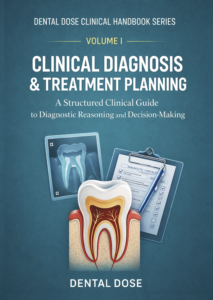
- Diagnostic frameworks
- Clinical examination
- Treatment planning
- Decision-making principles